They heard us now….

Yesterday, finally, we had Danny’s CSE (Committee on Special Education) meeting. It ended well – Danny got the placement that I would want for him, and when I would want it, given where we are now in the school year. More importantly – much more so – his ED (emotionally disturbed) label was removed from him.  His classification is now what it always should have been: Other Health Impaired (OHI) which is accurate given his need to have his diabetes constantly monitored.

But here is how I prepared for this meeting. First, I hired a CSE advocate. A calm, reasonable, brilliant strategist. She planned everything out; met with Danny and spent time with him, researched the law, and most important for me, she came to the meeting with me and advised me and the CSE every step of the way.  She gave me a big break on her fees, but still cost me hundreds of dollars.   She, in turn, referred me to a human psychiatrist.

Human psychiatrists are in contrast to the mechanical-by-the-book ones.  They are also much rarer. This one has her office one hundred miles from here. The psychiatrist meets with Danny and I first; then she meets with each of us individually. Then she attempts to get a handle on the whole picture, including all the horrific paperwork.  Lots of time on her part. Close to a thousand dollars – so far – on my end.

Then I asked my county caseworker – Danny is still technically a foster child – to attend the meeting by phone. She, in turn, asked her supervisor, the county director of adoption to also attend.  Not an easy thing to arrange given folks’ caseloads. But both of them attended (by phone) for the hour and a half meeting. That the supervisor pointed out that sometimes the family court judge has had so subpoena CSEs into court did not go un-noted by the head of the meeting. The judge would want to know why the child is not in school after so much time has passed. Well, it did not go un-noted by me that the head said that the CSE was very familiar with that kind of thing. Uh-huh.

And then there was Danny’s home schooling teacher, who gave an honest and full report on how Danny has been with her all these weeks. Her evaluation meant a lot, naturally, to these school folks and she pointed out that he could handle a regular school program.

I don’t suppose it hurt that I requested to tape the meeting. Of course, that couldn’t be approved until the school came up with their own machine to also tape. Mine was electronic; theirs required them to hunt down a cassette.  But tape it we finally managed.

And then, of course, there was me. Well aware of what I wanted; well aware of how I perceived Danny’s experiences the past two years – and articulate about both.

So it worked: they heard us now. Finally. All’s well that ends well and all that…..

But what if I hadn’t had a home equity line of credit to pay for these outside experts? What if Danny’s teacher was a cynical person simply waiting on her retirement date? What if the county didn’t participate? Or didn’t show their strong backing up of Danny and I?  What if I weren’t articulate? What if I knew nothing about these things and simply looked to the so-called experts to guide me through?  What if….any of those things?  Danny’s future should depend on all this?

And all because of the horrific reports that were sent onto the local CSE?  Reports done by very well paid experts. Reports that talked about Danny so that he was inevitably seen as essentially broken, damaged, and, by implication, no good. Not reports like I would write that require perspective, and hope, and, believe it or not about me, humility. Fr. Huntington defined humility for me decades ago as simply recognizing and defending the truth. Interesting definition, although I have probably distorted it in my memory.

Family Focus Adoption Services, where readers know that I work, has a rock bottom principle called the “Forty Year Plan.”  What it requires us to do is to look at the impact of the decisions we make now – on our kids or the families we work with – forty years from now.  That rule makes us look at things deeply, widely, and long long term.  Most importantly, it makes us look at things personally.  And that is what makes us stand heads and tails above any agency I’ve ever seen.  It also shows that it can be done.

The CSE did that long term perspective yesterday.  But do they do it routinely? Or because of what I brought to the table?  I don’t even wonder……

I don’t imagine there will be a need for me to write about Danny again. He’s now a regular kid, leading a regular life,  in a (more or less) regular family. That’s a happy ending.  He’s won the lottery (see last post).

Being his grandfather? So have I.

Jack
Posted in Uncategorized | 5 Comments

Kiss My…..

My last posting was on Monday, October 31. Friday, November 4th, Danny moved in.  Is it just me, or do you think there might be a connection?

The following Monday, I registered Danny in school, and today, five weeks later, Danny is still not attending school. Instead, the school district has placed him on home teaching, two hours a day (the state minimum for special ed students).  His IEP, the bible of Special Ed, recommended that he be in day treatment and/or in an 8 child, one teacher, one aide, (8-1-1) classroom. The district, claiming to have no such, is going to refer him to day treatment schools. Not try him in a 6-1-1 or a 12-1-1 or, imagine that: a regular sixth grade classroom. No. No chances to be taken with this defective human.

Prior to Danny moving in, I asked his social worker not to send in all the horrific reports to the school district as they all looked so bad. Academics only.  Her response – which even now is sitting in my craw – was that it would not be “ethical” to not send it.  Right…. But it is “ethical” to hold against an eleven year old boy all his behavioral reactions to being betrayed (see earlier posts) by the only family he ever knew – and then being blamed by them for their “having” to walk away?  What was he to do with all that pain, all that loss, and all that hopelessness for his future?  His parents left and took with them his siblings, cousins, aunts and uncles, and friends. They took his house, his bedroom, his toys, his clothes, his favorite recipes. With them went his neighborhood, his Church, his stores, and his school.  And in their place was left the hope that someone would step up for him. Someone no where to be seen, but someone nonetheless?

The fact is that in our culture when someone steps up for any familyless kid over the age of 3, it is the equivalent of the child winning the lottery.  There are no adoptive families for most of these kids. Add in his history, and his diabetes, and there will be no one. Short of winning this adoption lottery, there never will be any one. But Danny is expected to moderate his behavior; learn to speak – without being overwhelmed – about his feelings; and behave himself. Trust the adults. And be good, now spoken as “be safe.”

Danny was not good.  And you know what? I admire that. It says to me that Danny is a believer. He believed that he was being betrayed; that he was being thrown away; and that we, as a culture, could essentially not care less.  And that made Danny berserk.  Isn’t that a good thing?  Isn’t it good that he threw off these people who were trying to get him to accept these experiences? Isn’t it good that he wouldn’t tolerate accepting less than what every kid is entitled to?

So he became a “bad” boy. No one spoke to his issues, so he listened to no one.  That is admirable as I see it.  But then the powers-that-be wrote up their experiences of Danny from – of course – their Olympian point of view.  And these reports – for years, I have referred to them as the “damage reports” -followed him here because it was the “ethical” thing to do.

In the past five weeks, I have not had time to write this blog. Danny is here every day all day (today, one of my kids took him out with his cousins for a few hours.)  Danny keeps me busy; and my still locked up grief about Abe, slows me down.  But I’m not kept busy with calming Danny down; and chasing after him and his path of destruction.  There is no path of destruction. Danny is creative. Not once has he turned on the TV. Not once.  He builds things out of junk; he plays with his hand held games; he reads; he rides his bike; he does whatever little homework he has; he plays with his little cousins downstairs; and his big cousins up here.  There are no problems with him. 

He’s not in school. And still I have no problems with him?  What kid – even without his history – would be able to keep himself busy day after day after day without acting out in some way or another. But Danny doesn’t.  He’s not a saint. But he’s not evil incarnate. He’s an eleven year old.

And what if I had to work a 9-5 every day?  What would happen to Danny then? 

But no one from the school district wants to hear that. No one chooses to respond to Danny as a person. Or to me.  No one is giving him a chance. Because the reports – the damage reports – had to be sent to the school and must be listened to by the school.  Because it is “ethical” to do so.

Ethical?  I don’t care what the dictionary definition is: without a response to the wholeness of a person and the person’s situation, there is no “ethical.”  Without giving a person a chance to redeem themselves or accept responsibility for their own future, there is no “ethical.” By presuming that what happened in the past always and automatically determines the future, there is no “ethical.”

There is rule following.  There is butt-covering.  And always there is bureaucracy.

But “ethical?” Ethical?

They can all kiss my unethical ass. The fight is on.

Jack


Posted in Uncategorized | 5 Comments

Can a Gift Be a Weapon?

It has taken me months to do it, but I have finally finished sending out thank yous to the many many people who reached out to me and to my family when Abraham died.  Writing so many thank yous to so many people has gotten me thinking, because there were some folks whom I did not thank; some folks whom I could not bring myself to thank.

I think one of the earliest lessons we are taught, on our journey to becoming civilized, is to express gratitude for gifts for which we don’t feel grateful: grandma’s Christmas gift of socks; Uncle Charlie’s birthday gift of a book we wouldn’t read in a million years; Aunt Rose’s gift of a toy that’s more appropriate for our brother who is three years younger.  It comes as a shock to a kid, I think, to learn that it isn’t automatically phony to be grateful when we don’t feel that gratitude.

We are soon taught that it is the thought that counts, that a gift is always a good thing and not ever to be frowned upon.  And thus we are taught graciousness.

When I was in my twenties, my grandmother, a long time widow than in her seventies, and supported only by social security, still made sure to send me a birthday card every year. I found that thoughtful. But she always made sure to enclose two dollars.  That two dollars added little to my income, even forty years ago.  But I knew that it subtracted a lot from my grandmother’s.   I thought she was foolish to do it: the cost to her outweighed the benefit to me.

But when I turned twenty six, I had the opportunity to get into a special government mortgage program that would allow me to buy this house I am still in.  It required me to go on a strict – very strict – budget for over a year where every single penny literally mattered.  I had a hard time with it, but I was determined to take advantage of this opportunity, so I followed the budget religiously. And then my birthday came.

I don’t know that I have ever been so grateful as I was that birthday to open that card from my grandmother and find the usual two dollars.  It was totally unbudgeted money and I could do whatever I wanted to do with it. I suppose it would be the equivalent of about $15 today. It was a wonderful gift.

Yet, it was the same gift that she always sent.  Thankfully, I had changed and finally created the circumstances within which that money was experienced as it should have been: as a serious gift.  The objective value of a gift, I learned, depended on the receiver, not the giver.  So I get it. I do get it: gifts are to be appreciated. Recipients are to thank givers.

Years later, I read a remarkable book by M. Scott Peck named “People of The Lie.”  Peck – as I remember it – told a story about two teenaged brothers who each wanted to own a gun – hunting rifles, I think. The older brother finally got one. But he later used it to commit suicide with.  His parents took that gun, wrapped it up, and gave it to the younger boy for a gift that following Christmas.

Well, that made sense: the boy had wanted a gun; the family now had an extra gun; so why not give it to their son?  Well reasoned, or not, I was horrified – which was Peck’s intention.  While the objective value of a gift might well depend on the receiver, there also is always a context that must be looked at in doing that evaluation of the gift.

For instance, if I have two children, one by birth and one by adoption, it is not unheard of for grandparents to treat the birth grandchild as “real” and the adopted one as “less.”  We in the adoption world see it too often.  And if the grandparent were to buy a wonderful birthday gift for the birth grandchild, but either ignore, or buy a much less valuable gift for the adopted one’s birthday, the value of the gifts can only, and must, be measured by that context.  It’s not that one gift is acceptable and the other is not: both are unacceptable.  For a parent to allow the grandparent to do such would make the parent complicit in the grandparent’s very painful and disrespectful nonsense.

In both that scenario and in Peck’s story, gifts, no matter how they may look to outsiders – and they might look very good to outsiders, as they are gifts after all – can be used as weapons.  In those circumstances, although it goes against years of “gift” socialization within us, such gifts not only should not be thanked for, but such gifts need to be rejected out of hand and definitively.  It is not a particular gift, or even any gift, that one is demanding, when one does such, although it can be made to look that way. It is respect that one must demand, especially for one’s kids.  A gift, no matter how well-intentioned, given in a context where respect is missing, is beyond hollow. It is always perverse.

The gifts then, no matter the sincerity of the giver, are toxic.  And people we love, including ourselves, must be protected from toxicity – no matter how it appears to others.  The parents in Peck’s story – whether aware of it or not –are conveying to their son the message that he too should shoot himself.  The grandmother of the two grandchildren – whether aware of it or not – is hurting both children by treating them so differently – saying, in effect, that one is better or more valuable, than the other.  It is the parent’s job to say no.  Always to say no. No matter the consequences, with her mother, or any other relative in the family.  But to do that is scary and enormously difficult.

Yet, if we don’t stand up for our kids. than what’s the point of being parents? And isn’t being-stood-up-for the very thing that teaches us our value?  And isn’t that the core thing that parentless kids are missing?

Some thoughts……………as I prepare to pack Abraham’s funeral stuff into a box which will go into the closet with the boxes from the funerals of his – unbelievable – three brothers.

Jack


Posted in Uncategorized | 1 Comment

Error…..

Last mailing was an error from someone else. Deleted on the site, but I can’t call back emails. Please delete.
Jack

Posted in Uncategorized | Leave a comment

For Kathe…

This world of grief that I am living in gives me, I suppose, a taste of what it must be like for Alzheimer patients. I am forgetting regular normal things that I never forget. Yesterday, I was supposed to mail some papers to the government in the morning. Not only did I not remember to do it, but it didn’t even enter my brain for the entire day. Not once.  Only late last night did I suddenly remember and immediately I wrote it down – which is the only reason I remembered it enough to write about it here this morning. That is my now typical experience. Not only do I forget the thing, but nothing later on triggers the memory. It sits forgotten while I go about my merry way. Grrr…..

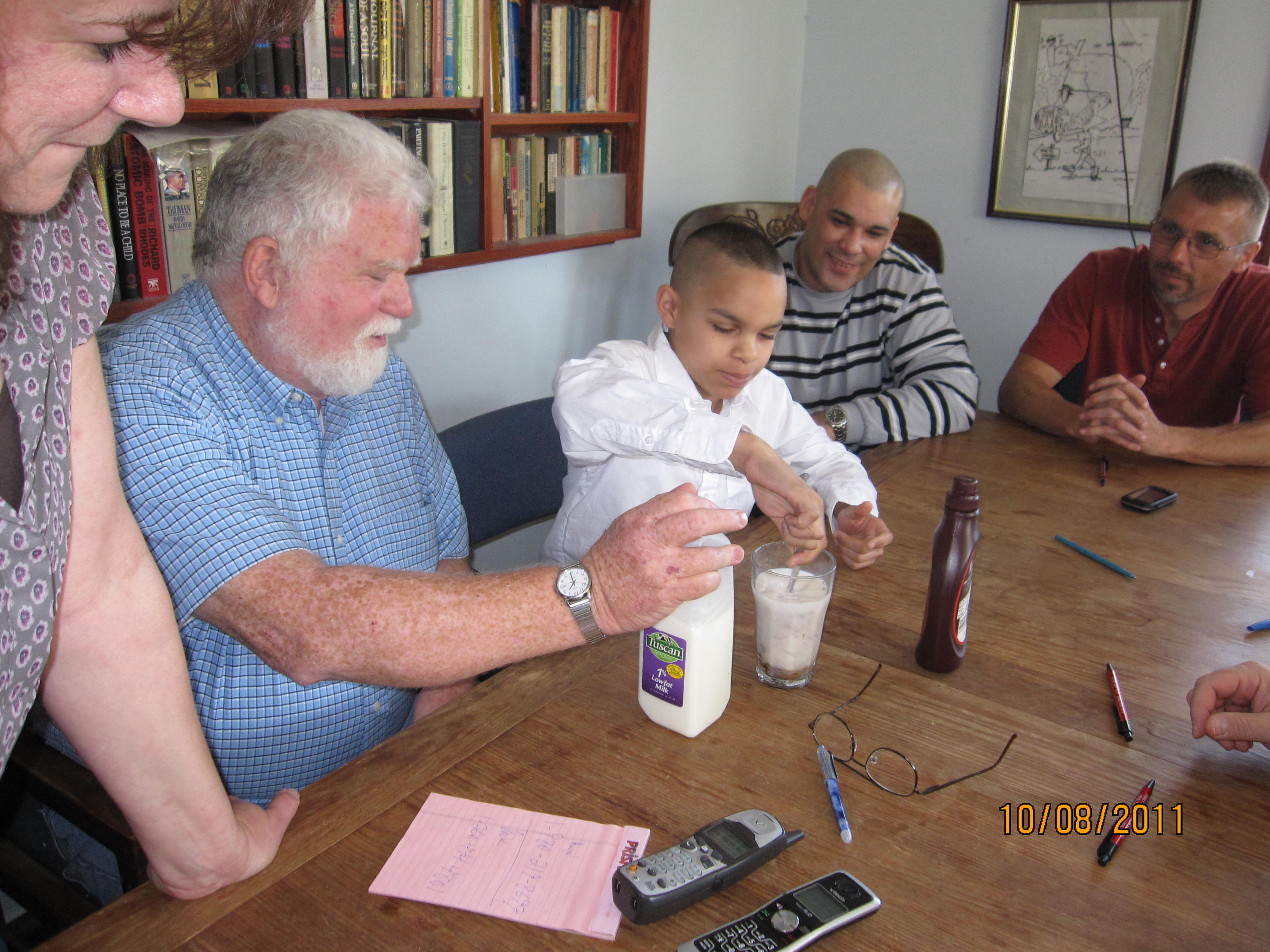
On the other hand, I am remembering things that did not happen. I suspect that has nothing to do with the grief though. It is probably just regular old-man stuff.  And so, in the last posting I sent a picture of Danny making a glass of chocolate milk, which I had referred to in the earlier post that day. And in the earlier post, I referred to the explanation in my original first or second post back in March when I began the blog. Well, lo and behold, there is no explanation there.  There is no explanation anywhere, as my direct supervisor, Kathe, has pointed out to me. My apologies to Kathe and to all of you.  The explanation:

When I met with the seventeen year old whom I wrote about in the first post back in March, I was looking for an analogy about the impossibility of a true adoption ever ending.  I asked the young guy if it were possible for him to get me a glass of milk.  He said it was. I asked then if it were further possible for him to make that a glass of chocolate milk. Again, he said it was. Then I asked him how he would change the milk from white to chocolate and he told me that he would mix the chocolate in with the milk and stir it up.

So then I asked him if I were to change my mind still again, would he be able to change the chocolate milk back to white.  He, of course , said no.  Thus, I told him, was the reality of an adoption.  An adopter is the milk; an adoptee is the chocolate. Once mixed together for real, it is impossible to ever separate them again.  There is no faking it, nor is there any “backsies.”  Once chocolate milk, always chocolate milk.  A broken down adoption (called a disruption prior to court and a dissolution post-court finalization) was never an adoption.  A hoped for adoption; a planned adoption; an intended adoption; a make-believe adoption; the illusion of an adoption; a conditional adoption. But not a real one.  Because a real one is like chocolate milk: it is impossible to ever go back. Ever.

Once one claims one’s child, one can never unclaim them.  A person – most of us – can have more than one parent after all – but none of us can have an ex-parent.  Some – even many – birthparents who surrender their children, but never their heart’s claim, know that.  I know that from both ends: Aunt Rita was my mother, albeit my second mother, but my mother, dead though she was, remained my mother.

Danny and I refer to his legally adopted parents as his fake parents or his foster parents. Never as his mother and father.  Those words don’t fit; they don’t describe the truth of the relationship. If they did, what he and I did on Saturday would not have occurred.

Adoption, like all parenthood, is unconditional, irrevocable, and forever final.

Like chocolate milk.

Jack


Posted in Uncategorized | 2 Comments

Nothing More Could Be Said

Posted in Uncategorized | 2 Comments

The Missing Page 2 of the Covenant

Posted in Uncategorized | Leave a comment

“Ted” – The Big Day

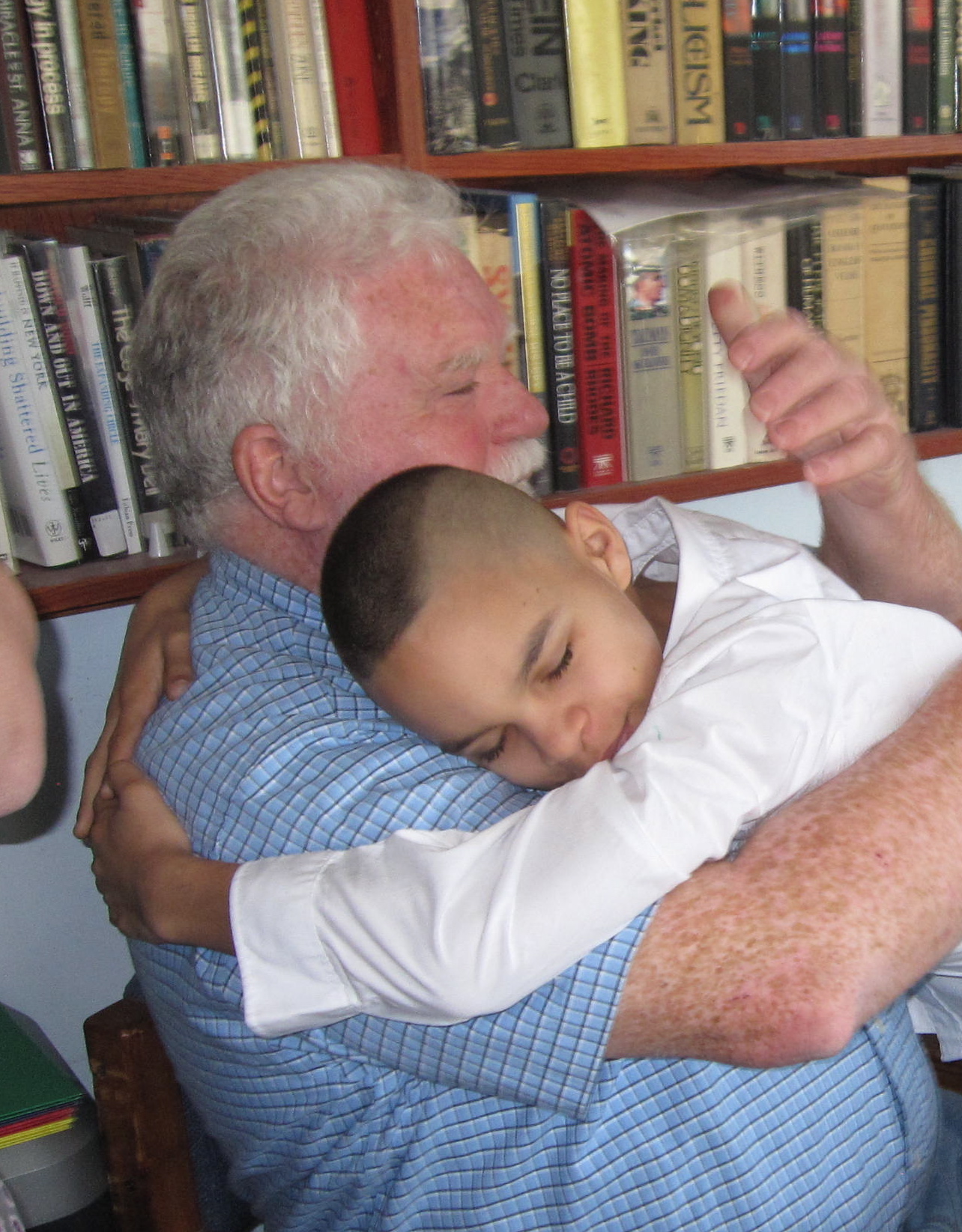
Though it seems impossible to believe now, it was only five weeks before Abraham’s beatdown that I made the decision to adopt “Ted” as his grandfather. I would not have had the strength to make that decision after Abe’s death, so I take it as sign from above about the rightness and the importance of the decision.  But let’s be clear: Despite my grief about the loss of Abe, I do not regret the decision to adopt “Ted” and I am very happy with him as my grandson.  His real name, by the way, is Danny.

Many years ago, Family Focus Adoption Services (commercial as always) recognized that the time of the moment of adoption – which is not the court moment-of-finalization of that same adoption – was unclear.  We knew when a newborn was adopted: it was the moment the agency handed the baby over to the family. But foster kids remain foster kids until the finalization. So when does their adoption actually occur?  There is no answer.

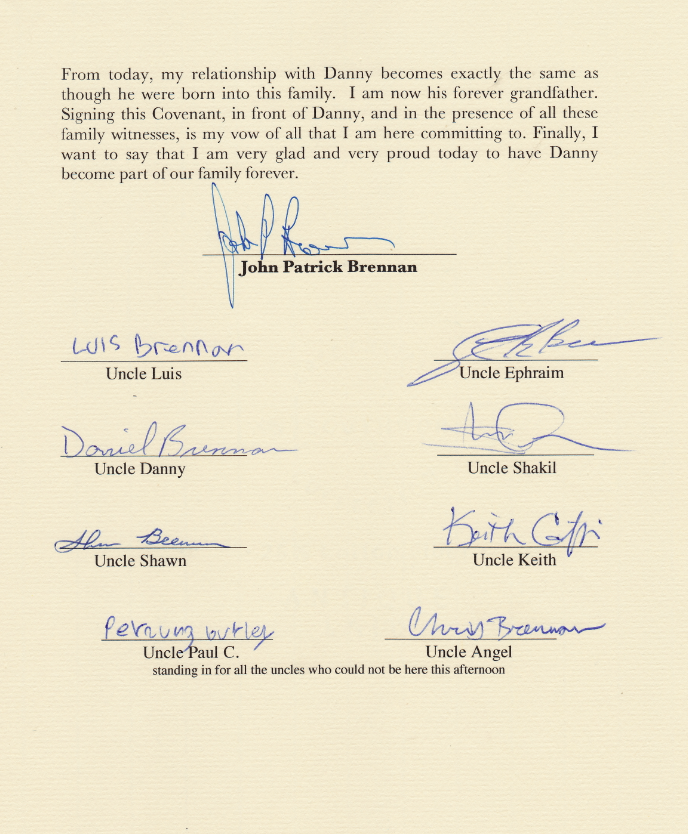
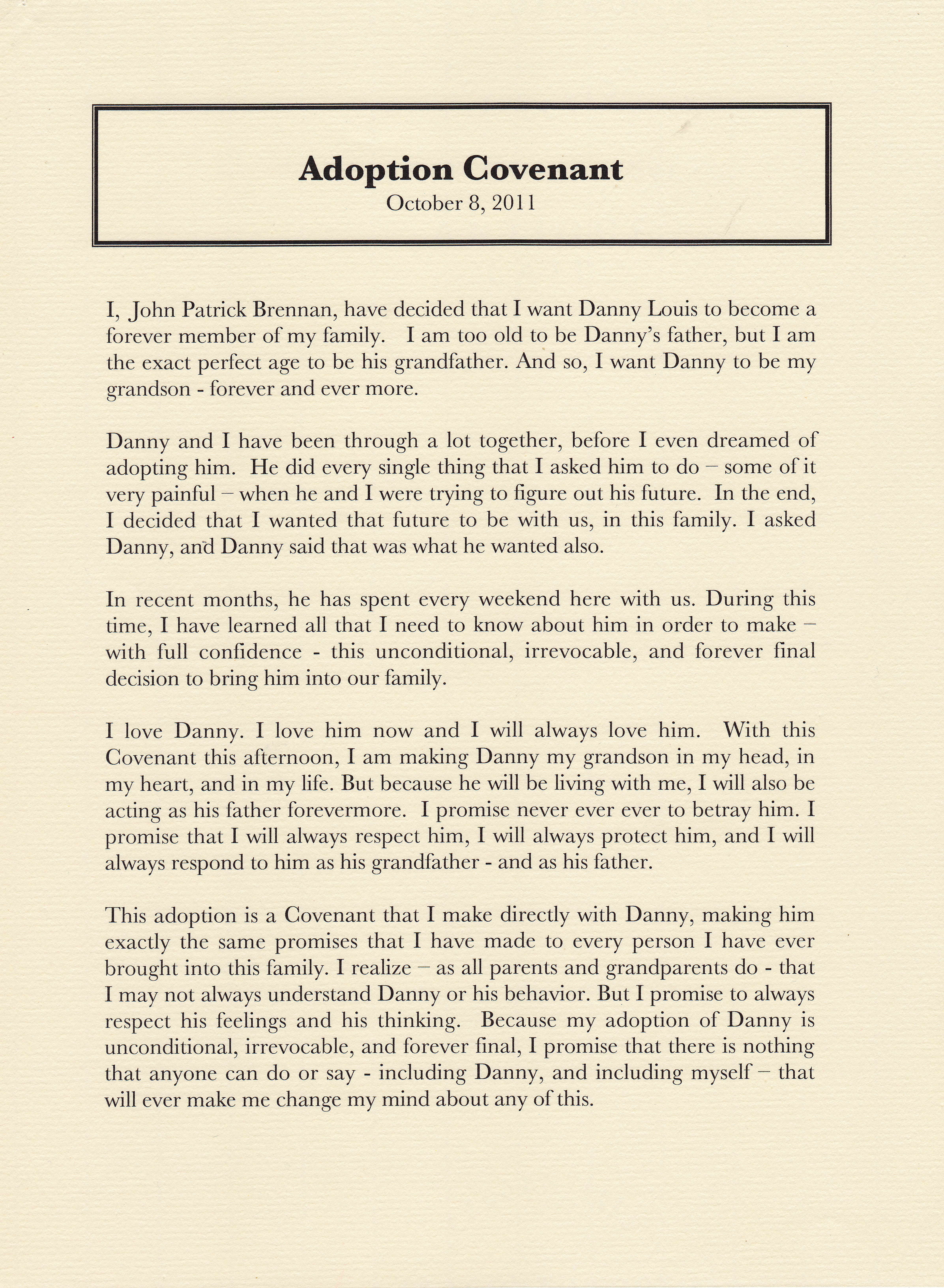
So we created an adoption ceremony – with a specific moment in time for when that adoption occurs. Our ceremony has no legal standing, at least in New York. But it has incredible psychological and spiritual standing.  At the ceremony, the adopting parent(s) sign Covenants. Then the adoptee signs a responding Covenant. On occasion, we have other family members sign what we call “Affirmations.”  These would indicate their acceptance of the adoption they would have just witnessed.

On Saturday, for the first time, I experienced the Covenant Ceremony from the other end.  As you will see from the attached Covenants, I adopted Danny – not yet court finalized, mind you.  It was among the best days of my long life.

I have debated whether or not I should post them in this blog, but finally decided that they are a gift to all who read the blog. I was going to change names and so forth, but what’s the point? Everyone reading this knows my name and can easily find out the names of those in my family.  However, those witnesses outside the family – that is, on Danny’s Covenant – I have not copied.

These Covenants were the very first where we used the word “betrayal.”  In Danny’s case there is no lesser word – see blogs from months ago.  But it is an appropriate word for almost every foster kid, I believe.

With Danny signing as he did (see below), we declared him adopted at the moment the last witness signed the last document. Believe me, we all felt the truth of that, no matter what the legal facts.

My colleague and friend, Joanne, ran the Ceremony and she added for the very first time an opportunity for Danny to mix real chocolate with real milk (see first or second post) as she – and Danny – explained to the crowd the meaning behind it.  It was a very powerful day. I hope the Covenants mean something to you.

A proud and happy grandfather,

Jack

Posted in Uncategorized | 2 Comments

Take It or Leave It

Abrahams’s death – and no, I still am not ready to accept it – has impacted for the worst my memory, my concentration, and my ability to focus on what I need to do.  Last week, I was an hour away from having my house fire insurance cancelled; Verizon did cancel my FIOS service.  The tax man sent me a threatening letter the other day for not paying my water bill. Just some of the many bills I still haven’t even looked at.

I have been here before – as I’ve said in earlier posts – and I have come out on the other side, but it took a year each time. At one point, after Irving and Ricky’s deaths (fifteen months apart), Luis came to me when I was sitting on the back porch and said to me, “Who are you – and what have you done with my father?” Yep.  I’m not as bad now as I was then, probably because I simply continue to block believing that Abe is dead. Even writing those words just now – Abe is dead – broke through what I don’t want broken through and my tears escaped from where I have them locked up.  No, I am not back to normal by a long shot.

And I am missing opportunities to write posts that I don’t want to miss. Including the about-time-they-start-to-get-it article* on plea bargaining from the front page – top story online – of this morning’s NY Times. Plea bargaining and its consequences, as detailed in the article, impacted Abraham’s life terribly.

I once believed that plea bargaining was a great idea: offer the guy a somewhat lesser sentence for a guilty plea to a lesser charge so that we avoid the hassles, expenses, and oftentimes pain for witnesses that a trial brings.  I figured that a guilty guy would jump at this chance and an innocent guy would simply turn it down, trusting that his innocence would trump at trial.  It was Abraham who taught me what the Times is teaching the rest of us this morning.

In words other than these, but essentially what he told me, when I told him that you do not plead to a crime that you didn’t do: “Pop, I have no money. And I am not white. Whether I did it or not isn’t the issue – although I didn’t. I am going to get a court appointed lawyer who will do a lousy job of defending me and I am going to lose. The gap between what the plea is offering me vs. what a trial conviction will offer me is too scary. I must plead to protect myself as best I can.”

And the Times affirmed this: two years with a plea could become fifty years with a trial conviction.

What???

In America???

What???

From the first page of the article:  “In some jurisdictions, this gap has widened so much it has become coercive and is used to punish defendants for exercising their right to trial, some legal experts say.” And later: “In Florida….felony defendants who opt for trial now routinely face the prospect of higher charges that mean prison terms 2, 5, or even 20 times as long as if they had pleaded guilty” [emphasis mine].

Among the worst things we can do to other people is to force them to use themselves against themselves.  If I am innocent, for me to plead guilty is a violation of my integrity. But to risk fifty years at trial, over the two offered in that plea, is a violation of my need to protect myself – in itself a violation of my integrity. Guilt or innocence are irrelevant: it is a cynical bargain to offer someone.

Damned if you do and damned if you don’t.  That’s how Abe experienced it.

There are values higher than punishing the guilty: which is why folks traditionally can’t testify against their spouses. And more importantly, why we have the Fifth Amendment.

Sophie’s Choice, as an analogy, has become long separated from the 1982 movie, and the (William Styron) book before it.  But for each of us, we immediately grasp the double horror of forcing a parent to choose between the lives of her two children. Either way, and apart from the children, how does one ever live with oneself? Either way, how does one ever avoid blaming oneself for whichever choice? Either way, how does one ever maintain one’s integrity? Or – the same thing – ever live whole again?

This no-win integrity-destroying-nonsense is what we want for our society? This helps us?  Protects us?

In what world?

For Abraham the consequences went far beyond the prison time he accepted as part of the simple plea he took.  I will post on that another day.

Jack

———————————————————————————–

*http://www.nytimes.com/2011/09/26/us/tough-sentences-help-prosecutors-push-for-plea-bargains.html?_r=1&hp


Posted in Uncategorized | 1 Comment

Where, indeed?

I read a letter written to our family the other day from the 24 year old girl who got one of Abraham’s kidneys. I wrote back to her yesterday. It’s all anonymous and it’s all through the donor network.  She’d had kidney disease since she was a newborn and she ended up chained to dialysis  for the past eight years.  That’s no life for someone her age. She was very happy, very grateful to be free of all that now that the kidney “took.” The operation of course was the same day – August 19 – that they took the organs from Abe.  A memorable day for both of us: a wonderful day for her and her family; far less so for me and mine.  I was very glad to hear from her though: her letter made me feel personally the wonderful power of this gift of organ donation.

As I wrote to her, I thought about the way in which her entire daily life has been determined by this terrible kidney disease she was born with.  Not so different, I thought – and told her so – than the many ways that Abraham’s daily life was determined by the circumstances of his birth to a drug addicted mother and his subsequent entry into the world – it’s more like an alternative universe – that we’ve named foster care.  What changed daily life for this lucky recipient was one operation three weeks ago today to get that new kidney.  What changed it for Abe was…..nothing.

Everywhere I look I see the same thing: blame, blame, blame.  It is as though we learn to blame ourselves as early as we learn to speak.  Apportioning the blame becomes our way of living.  I heard the line the other day from “Ted” about how whatever he had done that I was on him about, he had not done “on purpose.”  Where the heck did that nonsense attempted umbrella from blame come from in our culture?  Does it make a difference, really, whether we do it on purpose or we do it because we weren’t paying attention or we do it because we weren’t thinking or we do it because we don’t care enough to do it otherwise?  What matters is that we accept the responsibility for what we do, or don’t do. That is, what matters is that we recognize that we did something that we could have done differently had we chosen to. Or recognize that we didn’t do something that we could have done had we chosen to.  Aunt Rita taught me – and many others – that truth.

Responsibility means that we have to respond to the circumstances that we find ourselves in.  How those circumstances arose is an entirely different question – but it would still be a question of responding to the original circumstances, given our ability to do so as we were then.

Abraham was no more responsible for the circumstances of his early years than President Obama was for Abe’s life. But Abe was stuck with the consequences of those circumstances.  And the number one consequence, I believe, is that he believed that whatever happened to him was his fault.  That is how kids think: parents divorce? “It’s my fault.” Mother died? “My fault.”  Father a drug addict who left us abandoned? “I did something wrong.”

And “my fault” brings us right straight to blaming ourselves.  Blaming oneself must have some payoff for us, since it is so incredibly common.  Maybe it gives us a sense of control which allows us to block the deep pain of  our parents’ divorce, death, or abandonment. Hell, I am in the midst of blocking (much of) the pain from Abraham’s death.  I am well aware of it; I have written about it in this blog.  I am doing it right now as I write. But yesterday I realized that soon all the work related to Abe’s death will be done: the thank yous finished; the organ donations history etc. etc.  On that final day, when I put the cards away and so forth, Abraham will become part of my history; no longer present to me – and I dread that day mightily. My ability to keep blocking will end at some point, because the blocking is a temporary measure giving me control over my pain.  The key is the word temporary.

Whatever Abraham was dealing with from his history was obviously not history for him. Something was keeping the self-blame active and present and not temporary.  That something even led to him putting himself in the circumstances that led to his death.

That “something” is not unique to Abe. Almost everyone of us who loves our kids who have foster care histories, have experienced that non-self-protection of our kids.  But who the heck is working on it to figure it out; to help our kids – victims of the society we have created, or at the least allowed to remain the way it is – get past it?  Societies can change. I have lived long enough to watch cigarette smoking, e.g., move from acceptable and “cool” almost anywhere and everywhere to forbidden and “disgusting” almost anywhere and everywhere.  We have the power to change society.  Where is our motivation, our funding, and our belief in the possibilities?

Where, in other words, is the equivalent of a kidney transplant for our kids? On August 19th, at day’s start, while Abraham was in the operating room, this girl was suffering from her kidney failure.  On August 19th, at day’s end, she was not.  She didn’t solve her problem – we, as a whole society, did.  We invented this incredible transplant cure.  Where are the inventors for those who suffer like Abe?

Where, indeed?

Jack


Posted in Uncategorized | Leave a comment